From Country Lane to Urban Thoroughfare
Portobello Road was known before 1740 simply as Green's Lane: a winding country path that threaded from Kensington Gravel Pits (now Notting Hill Gate) northward to Kensal Green. Its transformation began in 1740 when Portobello Farm was established near what is now Golborne Road. The farm took its name from the Battle of Porto Bello, the 1739 naval engagement in which Admiral Edward Vernon captured the Spanish-ruled town of Puerto Bello in Panama. Vernon Yard, which still runs off Portobello Road, honours the admiral's name today.
The Potteries and Piggeries Era
The area's 19th-century reputation could scarcely have been less glamorous. The land around present-day Pottery Lane supplied heavy clay ideal for brick-making, and sheds lining the lane stored bricks and tiles fired in large kilns. The only surviving 19th-century tile kiln in London still stands on Walmer Road, bearing a commemorative plaque placed by the Royal Borough of Kensington and Chelsea.
After pig farmers were displaced from the Marble Arch area by London's westward expansion, they settled here alongside the brickmakers. Sanitation was minimal and fresh water scarce. Charles Dickens visited in 1850 and described the district as "a plague spot scarcely equalled for its insalubrity by any other in London." The Times had been equally scathing thirteen years earlier, describing "the dirty and dissolute vagabonds of London, a more filthy and disgusting crew...we have seldom had the misfortune to encounter."
The clay pits themselves became known as "The Ocean" — a vast pool of stagnant water, pig slurry, and sewage that dominated the landscape until Avondale Park was created on the site in 1892.
The Hippodrome That Failed
In 1837, John Whyte leased 140 acres from James Weller Ladbroke and constructed the Kensington Hippodrome racecourse. The venture lasted only five years. A public right of way across the land allowed residents of the surrounding slum to invade the course at will, and the racecourse closed in 1842. The circular track left its mark on the street plan: the crescent-shaped roads that circumvent the hill — Blenheim Crescent, Elgin Crescent, and Stanley Crescent — follow the line of the former racecourse.
St John's Church, completed in 1845 at the summit of the hill, stands as the centrepiece of the Ladbroke Estate development that followed.
Victorian Transformation
The arrival of the Hammersmith and City Railway in 1864 accelerated change. Ladbroke Grove station opened the same year (originally named Notting Hill until 1919), and the last open fields disappeared beneath brick and concrete. Portobello Farm was sold to an order of nuns who built St Joseph's Convent for the Dominican Order; St Charles' Hospital now occupies the former farmland.
By the second half of the 19th century, Portobello Road had become an urban highway. Shops and markets thrived on serving the wealthy inhabitants of the elegant crescents and terraces, whilst working-class residents found employment as construction workers, domestic servants, coachmen, and costermongers.
The Market's 160-Year History
The market itself began around 1863, originally selling fresh food like many other London markets. Today it stretches approximately 1,028 yards from Golborne Road in the north to Westbourne Grove in the south, with 240 market pitches managed by Kensington and Chelsea London Borough Council.
Antiques dealers arrived in the late 1940s and 1950s, gradually transforming the market into the largest antiques market in the UK. Saturday remains the main market day, when all five sections operate: second-hand goods, clothing and fashion, household essentials, fruit and vegetables, and antiques.
Post-War Decline and Recovery
The Blitz damaged or destroyed numerous buildings along the road, including All Saints' Church, which was hit in 1940 and again in 1944. The area became notorious for cheap lodgings and racketeering landlords. The 1958 Notting Hill race riots — disturbances from 30 August to 5 September in which mobs of 300 to 400 white people attacked West Indian residents — marked a low point.
From this troubled period emerged organisations that would reshape the area. Bruce Kenrick founded the Notting Hill Housing Trust in 1963, which helped drive new housing legislation before founding Shelter in 1966. The first Notting Hill Carnival took place in 1966; it now attracts up to two million people annually, making it one of the largest street festivals in Europe. A 2002 estimate placed its economic contribution at approximately £93 million, involving 40,000 volunteers and 9,000 police officers.
Gentrification and the Modern Era
By the 1980s, single-occupation houses began returning to favour with families able to afford them. The area gained a reputation as affluent and fashionable; by the early 21st century, the 1999 film Notting Hill had cemented its global image. Houses on Pottery Lane — once the heart of the piggeries — now command seven-figure sums.
Yet success has brought new pressures. Since at least 2000, independent shops have lost premises to multinational chains. In 2009, Lipka's Arcade, a large indoor antiques market, was replaced by the high-street retailer AllSaints. Urban studies cite Portobello Road as an example of "commercial gentrification," where rising property values and tourism pressure displace traditional vendors.
The 2011 Census recorded a 46 per cent decline in Black or Black British residents and a 28 per cent decline in White Irish residents in Kensington and Chelsea over the preceding decade. The Friends of Portobello campaign continues to press for preservation of the street's unique character and to resist further chain store encroachment.
Architectural Survivors
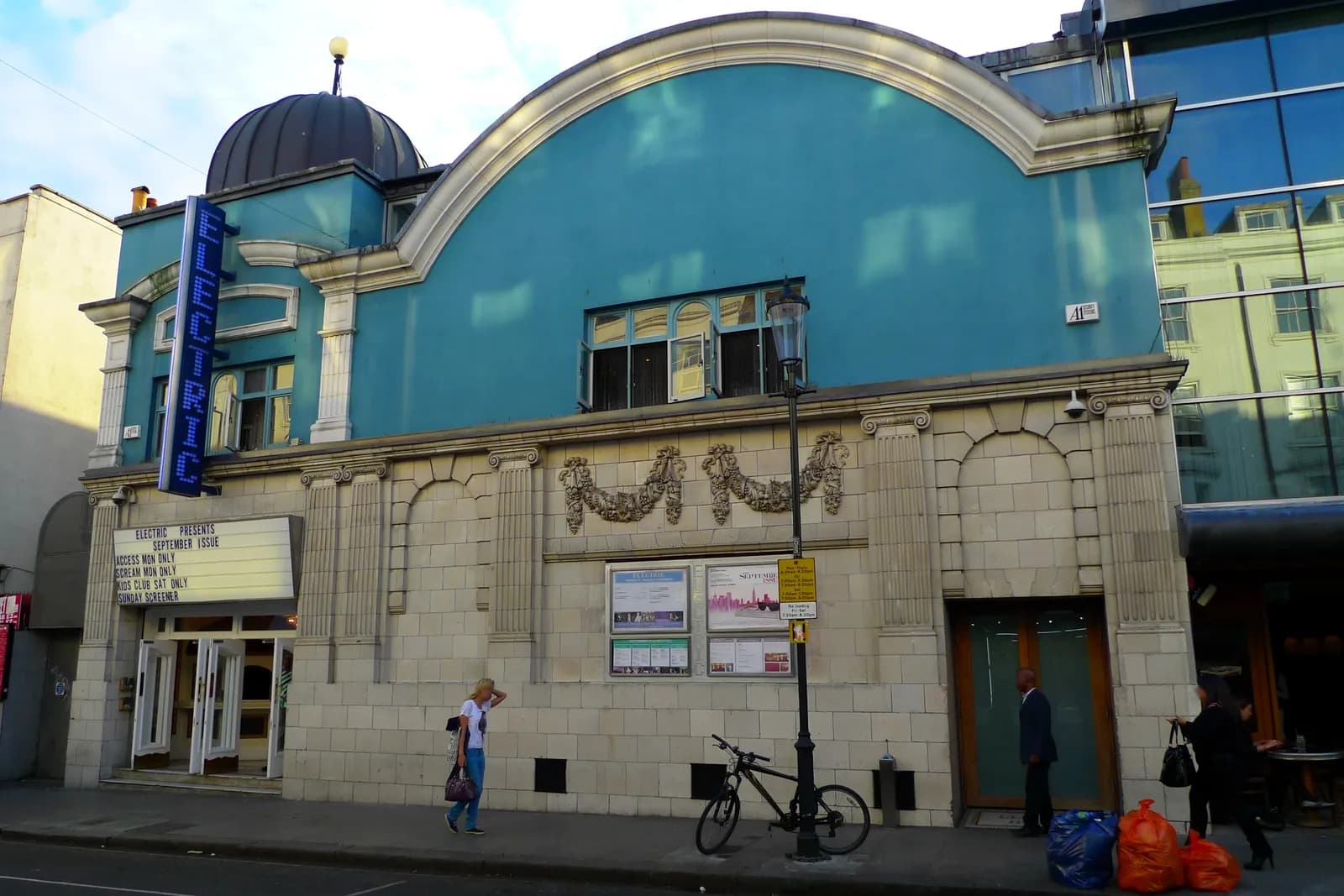
Amidst the changes, notable buildings remain. The Electric Cinema at 191 Portobello Road opened on 24 February 1910 as one of Britain's first purpose-built cinemas and one of the earliest buildings in the area with electricity. It became Britain's first black-owned cinema in 1993. Following a £5 million restoration by entrepreneur Peter Simon, the Grade II* listed building continues to operate today.
The road's physical character — meandering between mid- to late-Victorian terrace houses and shops — contrasts with the more formally planned layouts of nearby districts, a legacy of its piecemeal Victorian development.
The Market Today
Portobello Road Market operates Monday to Sunday, 8am to 7pm, though casual trader applications are currently closed. The council lists specific categories it is not accepting, including jewellery, clothing, and souvenirs — evidence of an oversaturated market seeking to preserve diversity.
The antiques trade remains the principal draw on Saturdays, supplemented by vintage fashion beneath the A40 Westway flyover, street food, and specialist retailers ranging from Reiki healing to organic skincare.
What began as a muddy track through hayfields and orchards, became a notorious slum of pig-keepers and brickmakers, and has since transformed into one of London's most recognisable shopping destinations. The reinvention of Portobello Road represents perhaps the most dramatic metamorphosis in Kensington's urban history.