Brompton Cemetery stands as one of Britain's oldest and most distinguished garden cemeteries, nestled in the Royal Borough of Kensington and Chelsea. Since opening in 1840, its forty acres have become the final resting place for over 205,000 souls, including suffragettes, scientists, authors, and romantics whose lives shaped the modern world.
A Garden Cemetery for the Living and the Dead
The cemetery was established by Act of Parliament in 1839 and opened the following year as the West of London and Westminster Cemetery. The site, formerly market gardens, was acquired from Lord Kensington and the Equitable Gas Light Company. Charles James Blomfield, Bishop of London, consecrated the grounds in June 1840.
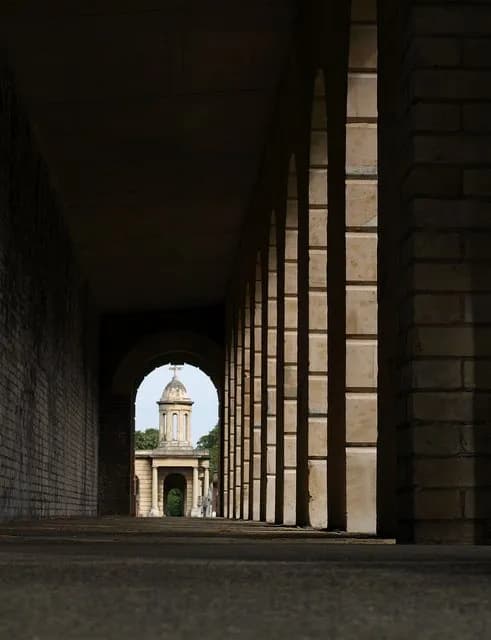
Architect Benjamin Baud designed the cemetery to evoke what he called a "large open-air cathedral." The rectangular grounds feature a central "nave" running from Old Brompton Road towards a modest domed chapel at the southern end, modelled on St Peter's Square in Rome. Two symmetrical colonnades flank the chapel, their catacombs originally conceived as a more affordable burial option, though only about five hundred of the thousands of available spaces were ever sold.
The Metropolitan Interments Act 1850 granted the government powers to purchase commercial cemeteries. Since 1852, Brompton has been Crown property, managed by The Royal Parks, making it the first and only London cemetery to hold this distinction.
Part of the Magnificent Seven
Brompton belongs to an informal group known as the "Magnificent Seven," a term coined by architectural historian Hugh Meller in 1981. These seven large private cemeteries were established in the 19th century to alleviate overcrowding in London's inner-city churchyards as the capital's population swelled from one million to 2.3 million in the first half of the century.
The seven cemeteries, in order of opening, are: Kensal Green (1833), West Norwood (1837), Highgate (1839), Abney Park (1840), Brompton (1840), Nunhead (1840), and Tower Hamlets (1841). Four were consecrated by Bishop Blomfield, but only Brompton remains Crown property and actively managed as part of London's Royal Parks.
Radicals and Reformers
Emmeline Pankhurst (1858–1928)
The founder of the Women's Social and Political Union lies here, her grave a pilgrimage site for those tracing the history of women's suffrage. Pankhurst died on 14 June 1928, mere weeks before equal franchise was achieved. Her militant campaigning, which included window-breaking and property destruction, drew both admiration and condemnation, yet her burial at Brompton marked the end of a struggle that transformed British democracy.
Dr John Snow (1813–1858)
The physician who traced the 1854 Soho cholera outbreak to the Broad Street pump rests beneath a funerary monument at Brompton. Snow's work proved that cholera spread through contaminated water rather than "miasma" or bad air, establishing the foundations of modern epidemiology. He also administered chloroform to Queen Victoria during the births of her children in 1853 and 1857, helping to popularise anaesthesia in obstetrics.
Samuel Smiles (1812–1904)
The author of Self-Help (1859) campaigned for parliamentary reform on Chartist platforms during the 1830s and 1840s. His book, often called "the bible of mid-Victorian liberalism," promoted thrift and self-improvement. Smiles died in Kensington and was buried at Brompton, his legacy tied to the Victorian gospel of work and personal responsibility.
Other Reformers
Eliza Phillips, co-founder of the Royal Society for the Protection of Birds, lies here alongside Dr Benjamin Golding, founder of Charing Cross Hospital. Sir John Scott Lillie (1790–1868), Peninsular War veteran and local West Brompton landowner, is also interred here. The cemetery contains over three hundred Polish burials, including Tomasz Arciszewski, Prime Minister of the Polish government-in-exile, alongside 289 Commonwealth service personnel from the First World War and seventy-nine from the Second.
Romantics and Cultural Figures
Fanny Brawne (1800–1865)
The fiancée and muse of John Keats met the poet in 1818 at Wentworth Place, Hampstead. They became secretly engaged in October 1819, but Keats died of tuberculosis in Rome in February 1821. Brawne married Louis Lindon in 1833 and died on 4 December 1865; she rests at Brompton under her married name, Frances Lindon. Her story intertwines with the tragic romance of the Romantic movement, cut short by the fragility of life in the 19th century.
Other Notable Burials
John Wisden (1826–1884), the cricketer who founded Wisden Cricketers' Almanack, lies here, as does Henry Cole (1808–1882), founder of the Victoria and Albert Museum and inventor of the Christmas card. Constant Lambert (1905–1951), composer and conductor, and his son Kit Lambert (1935–1981), original manager of The Who, share a family plot. William Banting (1796–1878), undertaker and pioneer of the low-carbohydrate diet, also rests here.
Architecture and Heritage
Brompton Cemetery holds Grade I listing in the English Heritage Register of Parks and Gardens of Special Historic Interest, awarded in October 1987. The chapel and each arcade quadrant carry separate Grade II* listings, whilst up to forty individual monuments have Historic England protection.
Approximately 35,000 monuments range from simple headstones to substantial mausolea. The tomb of Frederick Richards Leyland, shipowner and art collector, carries Grade II* status. The chapel's original Victorian flooring, featuring Bath and York stone in a radial pattern, was uncovered during restoration work between 2014 and 2018 after being hidden beneath carpet for decades.
A Working Cemetery in Modern Kensington
Closed to new burials from 1952 until 1996, Brompton is once again a working cemetery. Plots remain available for interments, and a Garden of Remembrance accepts cremated remains. The cemetery serves the diverse communities of Kensington and Chelsea, with many nationalities and faiths represented among recent burials.
The North Lodge entrance on Old Brompton Road and the South Lodge entrance on Fulham Road both welcome visitors. Pedestrian gates open from 7am to 8pm, though hours vary seasonally. A café and Information Centre, staffed by volunteers, provide refreshment and guidance.
The cemetery functions as an urban haven for nature, hosting birds, butterflies, bats, and beetles among wildflowers and mature trees. From 1854 to 1939, it served as the London District's Military Cemetery, cementing its connection to the military heritage of nearby Chelsea.
Today, Brompton Cemetery offers Kensington residents not only a place to remember the dead, but a tranquil green space within one of London's densest urban environments. Its avenues of stately lime trees and Victorian monuments provide a connection to the reformers, radicals, and romantics who shaped the modern world, now at rest in the heart of the Royal Borough.