In the Holland Park area of Kensington stands one of the most innovative houses of the Victorian period, a testament to artistic ambition and cross-cultural inspiration. Leighton House Museum, the former home of painter Frederic Leighton, has been captivating visitors since 1929 with its extraordinary Arab Hall and the legacy of the Holland Park Circle.
The Making of an Artist's House
Frederic Leighton, later 1st Baron Leighton, began building his Kensington home in 1866 on Holland Park Road, securing a 99-year lease from Lady Holland. The architect George Aitchison, then Professor of Architecture at the Royal Academy, was commissioned to design a combined residence and studio. Construction was completed by the end of that year at a cost of £4,500, equivalent to roughly £494,000 in today's terms.
The house was constructed using red Suffolk bricks with Caen Stone dressings in a restrained Classical style. Over the following three decades, Aitchison and Leighton would collaborate on numerous additions and modifications, creating what architectural historian J. Mordaunt Crook described as "one of the most innovative houses of the Victorian period."
The Arab Hall: Centre of Islamic Splendour
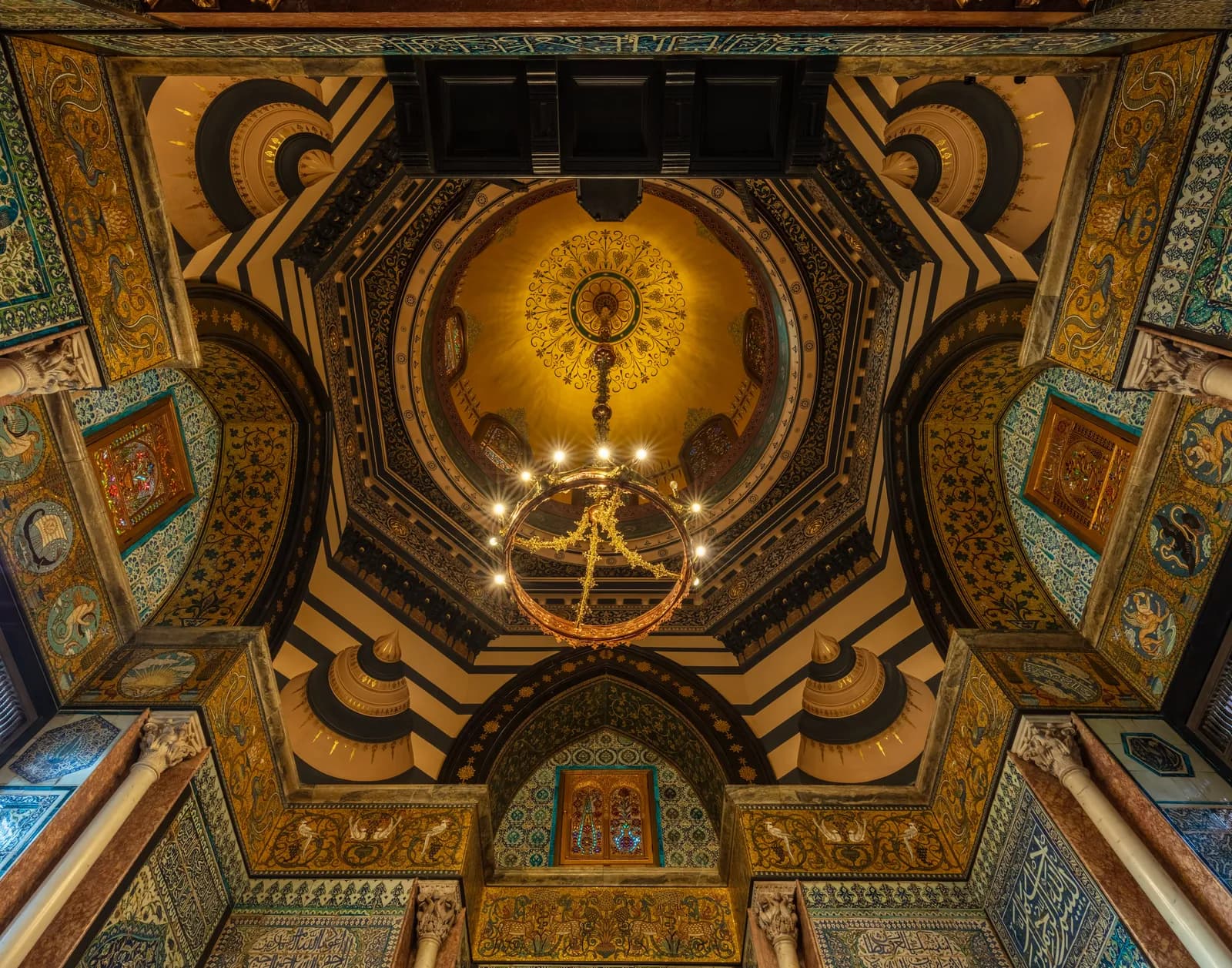
The most celebrated feature of Leighton House is undoubtedly the Arab Hall, added between 1877 and 1879. This two-storey extension was purpose-built to house Leighton's extensive collection of tiles gathered during his travels to the Middle East.
The design drew inspiration from the palace of La Zisa in Palermo, according to contemporary accounts from Aitchison and the artist Walter Crane. The hall is dominated by a central fountain set beneath a vast golden dome, surrounded by intricate decorative elements. The tile collection includes 17th-century pieces from Damascus, large 16th-century Turkish tiles, and 14th-century tiles on the west wall. Seventeenth-century carved wooden lattice-work windows from Damascus complete the authentic atmosphere.
Victorian craftsmen contributed their own artistry to the space. Sir Joseph Boehm created capitals for the smaller columns based on Aitchison's designs, while Randolph Caldecott carved the large column capitals in the shape of birds, later gilded. The mosaic frieze was designed by Walter Crane, and the marble work was executed by George P. White.
The Artist and His Legacy
Frederic Leighton was one of the most prominent artists of his generation. Born in Scarborough in 1830, he became President of the Royal Academy in 1878, was knighted at Windsor Castle that same year, and was created a baronet in 1886. In January 1896, he became the first painter to receive a peerage when he was made Baron Leighton of Stretton. Tragically, this proved to be the shortest-lived peerage in British history; Leighton died at his Kensington home on 25 January 1896, just one day after the patent was issued, leaving the hereditary title extinct.
Beyond his painting, Leighton served as Lieutenant Colonel of the Artists Rifles, having joined the 38th Middlesex (Artists') Rifle Volunteer Corps in 1860. His ceremonial sword, presented in recognition of his service, remains on display at the house.
The Holland Park Circle
Leighton's presence in Kensington transformed the area into a magnet for artists. His house became the centre of what became known as the "Holland Park Circle," a remarkable artistic community that developed in the late 19th century. By 1896, six Royal Academy Academicians were living on Holland Park Road and Melbury Road, including Leighton, Prinsep, Thornycroft, Watts, Stone, and Fildes. The Post Office Directory of that year identified over twenty residents of these two streets as artists.
Leighton's house made Holland Park Road "a Mecca for aspiring artists," establishing Kensington as a significant centre of Victorian artistic life.
From Private Home to Public Museum
Following Leighton's death, the house opened to the public in 1929 following the addition of the Perrin Galleries, designed by architect Halsey Ricardo in memory of artist and sculptor Muriel Ida Perrin. The museum is now run by Kensington and Chelsea Borough Council as a companion to 18 Stafford Terrace, the preserved home of cartoonist Linley Sambourne.
The house was awarded the European Union Prize for Cultural Heritage by Europa Nostra in 2012 and is Grade II* listed. It houses 81 oil paintings by Leighton alongside works by Pre-Raphaelite artists including John Everett Millais, Edward Burne-Jones, and George Frederic Watts. The collection also includes approximately 700 drawings spanning Leighton's entire career.
The £8 Million Transformation
After several years of extensive work, Leighton House reopened on 15 October 2022 following an £8 million refurbishment. The project restored the Winter Studio, added in 1889 to allow Leighton to work during London's dark, smoggy months, and removed what had been described as "crass surfacing" added by the council in the 1920s.
A new extension brought additional exhibition spaces, a learning centre, step-free access throughout, and the De Morgan café with views onto the restored garden. A striking new spiral staircase features a circular mural entitled "Oneness" by Iranian-born artist Shahrzad Ghaffari. A subterranean exhibition space now houses Leighton's extensive collection of drawings.
The inaugural exhibition following reopening, "Artists and Neighbours: the Holland Park Circle," recalled the artistic community that once thrived in the area.
Visiting Leighton House
The museum is located at 12 Holland Park Road, Kensington. Its Arab Hall has achieved cultural recognition beyond the art world, appearing in films including "Nicholas Nickleby" (2002) and "Brazil" (1985), as well as in music videos for The Stranglers' "Golden Brown" and Spandau Ballet's "Gold."
The house stands as a unique example of Victorian Orientalism and the Aesthetic Movement, offering Kensington residents and visitors alike the opportunity to step inside a private world where art, architecture, and Eastern inspiration combined to create something truly extraordinary.